Did you miss...?

Aurora on the Home Front

Northern Lights seen here in Sequim! May 10th and the Northern Lights popped by for a visit. I am happy to see them, but honestly, how DARE ...

Wednesday, May 12, 2010

Down El Dorado Way


Vacation with my birding friend Don was already at the halfway mark, when we headed south for El Dorado Arkansas. El Dorado is a quaint little town just a few miles north of the Louisiana state border. Nothing I love like long drives while on vacation, particularly if someone else is doing the driving. We found no reason to oppose the motto calling Arkansas "The Natural State". It was natural enough and untamed enough that it not even one bar registered on my iPhone during much of our drive, and I gave up trying to use the cell's GPS system. Ah! That's my kind of 'natural'.


Wide view of Bayout Metro Wildlife Management Area


Bayou's Visitor Center and Observation Tower

A good deal of the drive had us motoring past the watery vista of White River National Wildlife Refuge. We put in a short visit at the Bayou Meto Basin; set up for flood water control and wildlife habitat. As we parked on a large berm overlooking a marsh we knew we had the place to ourselves, except for the presence of a host of waterfowl, including Red-necked Ducks, Moorhens, Blue-winged Teals and the usual line up of geese. I enjoyed watching a young male Orchard Oriole traversing a small patch of wildflowers.

Warren Prairie Natural Area

Next we scanned country roads and found the Warren Prairie Natural Area, a Nature Conservancy spot. We (i.e., Don) walked up and down but there just weren’t that many birds around, perhaps because of the time of day. I busied myself admiring the local wildflowers, some of which were beginning to seem common place now, such as the Showy Primrose, and Dayflowers, but others seemed rather showy and occasionally outright bizarre.


pink Showy Primrose


Wild Petunia


Hairy Skullcap; a weird name for a pretty flower


Yellow Tickseed and Spiderwort flowers

One of the most exotic wildflowers of the trip was a small patch of white flowers with strange long petals. The blooms were on the other side of a rivulet so I actually took the photo below with a hand held long-lens – it doesn’t show the flowers well so I nicked a photo of them from the Internet to show off how pretty they are – close up.


My sad little Spider lily photo


Spider Lily nicked from Internet


Fringed Bluestar


Ear-flowered Lobelia

We drove to around the area and found a pine-woodlands spot where Henslow’s Sparrow was a no show. But dilgent Don called me over into a meadow to enjoy Brown-headed Nuthatch, which were for me, the lifer species of the day. The nuthatches were cute, fluffy and chatty little birds. My photo below is a bit washed out for being backlit, but you can see the sniffy attitude the little mite had as it watched us watching him.


My lifer Brown-headed Nuthatch

Later that day we finally reached our goal, El Dorado Arkansas. There, from the quaint streets of beautiful old homes we ferreted out the one belonging to a friend of Don’s from the Bay Area - Jerry Derrick. Jerry generously agreed to let Don and I stay at his home while we were birding the area.


Don and Jerry in El Dorado Arkansas. On the right you can see
an arbor with vines where Mockingbirds were nesting.

There is always something you remember about places and I’ll always remember how kind Jerry was, how eager to please and how fantastic he is at crossword puzzles. And one other thing – Jerry had an active Mockingbird nest on an arbor at his front door. We each climbed onto a chair for a quick peek at the nestlings.


Like all babies, especially cute when asleep


FOOD! NOW!

Our first day trip in the El Dorado area, we headed for the Felsenthal Wildlife Refuge. First up we visited the refuge visitor center. And as we walked up to the building, for the hundredth time I scratched at a spot on my back at my waistband. As I did so, it suddenly occurred to me; this was no prickly heat, this is a $#&% tick! In the center, as Don questioned a Ranger about locals for finding key birds, I grinned sheepishly at a lady Ranger and tried to sound as normal and sane as I could manage, so as not to have her become frightened of the crazy Black woman.

“Is there a place here, maybe a closet or store room where we can have a little bit of privacy?”

“Why?” she asked, sounding a tad concerned.

“So you can remove a tick from my back,” I pleaded.

“Oh a tick! Why didn’t you say so,” she smiled.

I was relieved she wasn’t repulsed. We moved a little into the visitor center where she quickly removed the tick from my hide. Just at moment I realized the prickly heat at another waste band spot was also not just a rash. She removed that one too.

“In Minnesota the bad ticks with Lyme disease are really small," I explained. "A
couple of days ago I pulled off a couple of small ones that were attached, just above my right knee.”

“Hum…” she mused as we stared at the dead ticks (you can see 'my' tick --->). “I don’t know about size, but what you don’t want to see on ticks around here are a white spot on the tick’s back.” Deftly she flipped over the ticks. No surprises I guess, one of the two ticks had a big white spot on the center of its back.

I silently swore at the Shelby Forest gods as the lady slipped my portable moles into an envelope.

The Lady really was impressive. She spent another ten minutes adjusting three Blue Goose Passbook stamps for my visit. I was tickled to acquire the stamps for Felsenthal, Overflow and Pond Creek National Wildlife Refuges. Then, de-ticked, fully stamped and mapped up, Don and I headed out to see the refuges I'd just recieved the stamps for.

Our big goal of the day to find Stilt Sandpipers. Bugger all if the stilts, a potential lifer for Don didn't manage to elude him for the entire trip, just as a lifer Louisiana Waterthrush eluded me. Sometimes being in the right place in correct season doesn’t mean diddly if the birds aren’t cooperating. We did have luck with other birds, though, repeats for us, but fun to see none-the-less. We spent some time watching a couple of nesting Red-cockaded Woodpeckers that busily pounded away at pine trees, high up, well out of range of good camera shots. And after crossing a small bridge over a creek we located a Yellow-throated Warbler that was fast, but happily not too fast for me to get nice “look what I saw” shot.


Yellow-throated Warbler


White-eyed Vireo spotted in the refuge

Our second day out of El Dorado we took Jerry’s recommendation, heading south for a day in north Louisiana.

There at the D’Arbonne National Wildlife Refuge I joyfully 'scored' stamps for D’Arbonne and the Ouishita Refuges.


So, what's at D'Arbonne?

Our first stop on the actual refuge was the equivalent of a sunken bowl, around the edge of which we crept along by car and or/foot. It was still fairly early in the day but the birds, though loud, were relatively sparse. We still looked for the Stilt Sandpipers but only saw a lone Spotted Sandpiper. The biggest excitement for me was spotting a lone Swamp Sparrow; it was the first time I was able to find and identify the species for myself.

Later in the day, we took out the spotting scope to admire a pair of entertaining Bald Eagles. Shortly after headed back towards El Dorado, we parked roadside so Don could take a call from his sister back in the Bay Area. As he hung up, Don excitedly said he’d heard a Prairie Warbler. He went across the street and sure enough, a nice Prairie Warbler gave Don a fine’ Louisianan How-d’ja-do’; Don had a lifer species to commemorate the one day visit to north Louisiana.


Sleepy Riverside in Millwood Lake State Park

Day three we headed to a southwestern spot of Arkansas to an area called Millwood Lake State Park. To me, and like some of the spots we saw the day before in Louisiana, I thought this bit of Arkansas reminded me of the wetlands Florida. Like Florida, a number of Little Blue Herons and White Ibis waded or winged by overhead.


Bit of Swamp at Okay Dike Area

Don took a short hike along a spot called the Okay Dike (no sniggering please) while I stayed with the car, sweating and searching the lily pond laiden waters for signs of Little Blue Heron’s close enough to get shots of. No such luck with herons, but I did see some nice butterflies and wildflowers. The butterflies were especially 'cooperative', flying right into the rental car and quietly posing.


Hackberry Emperor butterfly


A slightly bizarre American Snout butterfly

We then found a spot with an overlook to a lake, set up and maintained by the Audubon Society. Nothing with wings or fur was visible from the overlook so we meandered to a spot with picnic tables nearby. The late nights chatting with Jerry caught up with Don and he stretched out on a picnic bench and hat on face was soon cutting z’s. Meanwhile I played a few bird calls from my iPhone and admired several small birds that shot in and out of the shrubbery & trees. There were Kingbirds, Vireos, and both Orchard and Baltimore Orioles. It was the first time I noticed a size difference between the two; the Baltimore Orioles made the Orchard Orioles look positively petite.

Then, in answer to my calls a beautiful Summer Tanager showed up and gave me the best shots... uh, shot, I got on the entire trip. When Don woke, the Tanager was still staring at us, as if it had paid admission and was bound & determined to get its money’s worth out of us.


Summer Tanager


Same Tanager, leafier pose!

We headed out taking a driving route through the northeastern corner of Texas through Texarkana where we stopped at a Texas McDonalds – a fast food joint I usually avoid like the plague – where we bought wonderfully refreshing, fat & calorie laden coffee drinks - Yummy! With Texas that made five states we at least briefly visited during our trip: Tennessee, Arkansas, Mississippi, Louisiana and Texas.


Home of 'Texas T'...
er... Texas Cold Coffee!

We had stayed with Jerry three days and four nights, getting up each day and taking off to bird, then returning evenings for a rest up and dinner out to Jerry’s favorite local spots. One night we stayed in for a great home cooked chicken dinner. While there I totally felt at home and felt lucky to have enjoyed such good old fashioned, down home, southern hospitality.

On our way out the last morning at Jerry’s house. Before we left for our last leg of the trip, we took one last look at the now four day old family of Mockingbird babies. They really did grow a good deal in the course of the week.

There was a lot of bird life around Jerry’s house. As we prepared to leave a Red-headed Woodpecker drummed away on a telephone pole at the curb. Here are some photos I took of Jerry’s wild friends, Brown Thrashers, during the week.


Hum... which end of this worm is which...


Ok, I've got it the right way round now...


Hang on belly, here it comes!


Look kid, I can't swallow it for you,
you'll have to do some of the work yourself!

Friday, May 07, 2010

At Home in the Land of Grits and Yo-yo Fishing


The sun might just shine bright on some old Kentucky home, but when Don and myself headed out headed out to find a a Painted Bunting, it shown even brighter, and just for us. The previous day Jerry ‘Old Coot’, gave us directions to a special bird he’d scoped out at the entrance to Wapanocca, a National Wildlife Refuge. Shucks, I couldn't say Wapanocca without giggling - yes; I am that immature. So, after giggling over our motel breakfast bar discovery of packeted ‘Instant Grits’, we found ourselves staring at roadside trees, looking for buntings on roadside trees near by the Wapanocca entrance sign.

Instant Grits – a product, I think not found, west
of the Mississippi or north of the Mason Dixon line

There are several species of Buntings in the U.S., but the loudest, most garishly… uh, strikingly colored and striking is the Painted Bunting. Up to this morning I had only ever seen one female Painted Bunting; a nearly drab olive birdie job, down in Florida. So this bright Tennessee morning, I was nearly as excited about seeing the male Painted Bunting as was Don, for whom the bird would be a lifer species. There were no disappointments - Hurrah! Don spotted a brightly scarlet-bellied male Bunting, that was utterly shameless in its coloring. While Don admired the singing bird, I swore so badly it is a wonder the critter did not just fall out of the tree. I was miffed, as usual - the bird being too fast for me to get even a crap photo off. Here’s a pic I nicked off the Internet.

High Fives all around for the Painting Bunting! photo by someone other than me

With a gem of a bird ticked off, and we were off to explore the rest of Wapanocca. It’s a pretty little refuge with large fields with all sorts of habitat, from green meadows sprinkled with saplings to gator-ridden cypress swamp. To make up for the missed Painted Bunting photo op, a very cooperative and cute Yellow-billed Cuckoo posed for me as it perched on a shrub, wolfing down caterpillars. Some birds are just awesome even if their bellies are not fiery red.

The totally laid back & cooperative birdie, a Yellow-billed Cuckoo;
common in the south, rare in California

Eventually we wended our way to the wooden boardwalk where the previous evening we’d heard Least Bitterns calling. It was wonderfully cool and rather breezy so not too many critters were stirring or calling. After a bit, Don took off on a birding walk. I stayed put on the viewing platform, stubbornly staring haplessly across the swampy lake, watching Moorhens and such, enjoying the breezy cool morning. After perhaps a half hour, I saw in the distance, a flapping heron-like bird. I gasped - I was viewing Least Bittern, puddle jumping across water reeds. Hallelujah, pass the plate! The Least Bittern was now firmly on my life species list as a ‘seen’ and not just a ‘heard’.

Helecoptering’ Least Bittern photo by Trisha Norton

The remainder of the day was spent diddling around searching for new birds, sights and sounds. Though we didn’t score any new birds, I did get my Wapanocca National Wildlife Refuge stamp in my Blue Goose passbook. Thank you for feigning being thrilled for me.

Don scoping the flooded terrain at Eagle Lake

The following morning we rose for the last time in West Memphis. After our morning giggle over grits biscuits and gravy, we were out early, on the hunt for exotic warblers in Meeman Shelby Forest State Park. Deserting the car – an act that, yes, I admit, often enough caused me to whine and fuss. Happily, like me, most birds enjoy a good squawk and fuss in the morning. So as we walked down a forest road, winding down a path flanked by tall shrubs and trees hung with Tarzan vines, the forest echoed with morning birdsong. Don has become quite the expert at recognizing bird calls. In bird calling I’m barely at kindergarten level, but between Don and myBirdjam bird recordings, I could pick out a few. Don could hear and point out Carolina Chickadees, Bluegray Gnatcatchers, Tennessee Warblers and White-eyed Vireos. Soon I was hearing and recognizing the upswing of the beautiful little Parula Warbler’s rising notes and the back and forth ‘I am here, where are you’ notes from Vireos and Orioles.

There were also bright butterflies to stare at and try for photos of and just about every kind of forest bird you would want – except of course the two species we’d come to the area for: the Cerulean and Swainson’s Warblers. Drat! Still, no complaints from me, we found a curious Kentucky Warbler – a lifer for me, and a way-too-speedy Hooded Warbler.

We played Peek-a-boo with my lifer Kentucky Warbler

Hooded Warbler

A Southern Tulip Tree; one of many amazing southern trees

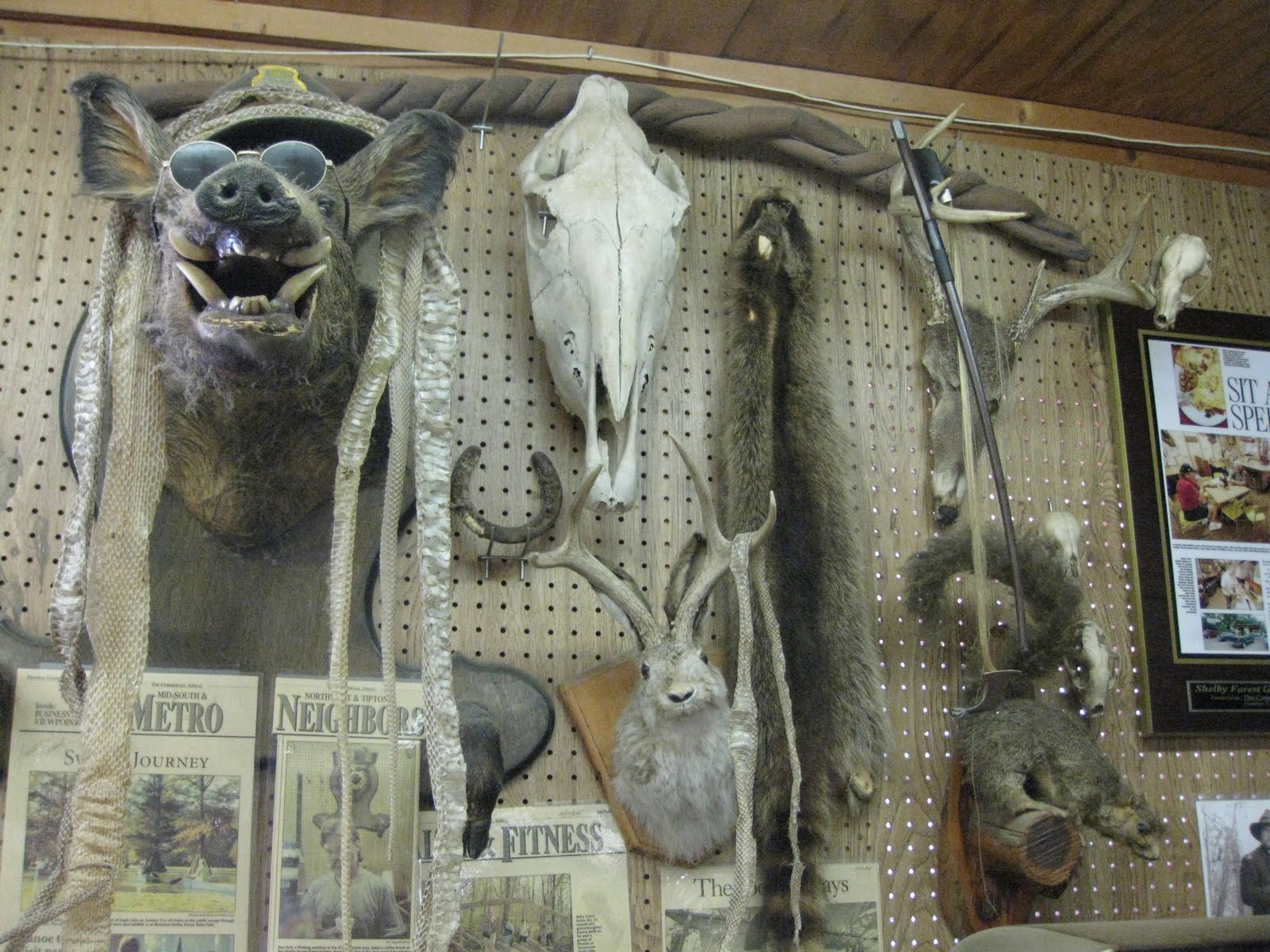
When we left the forest I was tired and well on my way toward cranky. We stopped to buy lunch at the Shelby General Store, a spot Don remembered from his visit to the area 4 years earlier. The little grocery was a local historic spot and I totally had to appreciate it for it’s down home STUFF.


Click here or on picture to read the Sign

Grocery’s friendly, pet-able spokes-chicken, 'Jake'

Welcoming and Smiling faces in the Shelby General store

Testament to the local hunter & fisherman's prowess

Not only did the Shelby General Store have loads of cool stuff to stare at and collect dust, but it sold tasty sandwiches served up with loads of southern hospitality. I got greedy and treated myself to a genuine ‘Moon Pie’and a Goo-goo Cluster. Afterwards, I meandered outside to picnic tables on the grocery’s side porch where I watched a friendly man setting up for his one-man afternoon performance. We chatted a bit about a humongous mulberry tree that not only provided me with enough semi-tasty free fruity berries to serve my healthier dessert needs, but provide the fruity needs for a large flock of Cedar Waxwings. The waxwings are the same species that hit my Hawthorn Tree every winter. I was a little surprised to see such bird not only because we were so far south, but because I seldom see waxwings outside of Autumn/Winter. After buying lunch, Don and I headed off to more birding as the soft chords of a Blue Grass Love Song faded into the distance

Juicy Mulberries

We didn’t get too far before Don pulled a U-turn; there was a large turtle playing chicken by crossing the road - Photo Op!

Photo of a poofy-eyed, ill-groomed drowsy creature
more secretive and less photographed than Tennessee Turtles

We attempted to get a cabin at Village Creek State Park. As it was a Saturday, we were not surprised the park was full up. So after getting rooms in Forest City, Arkansas we headed back to the Park. The park was alive with birds; Chimney Swifts zippering the sky, families of Eastern Kingbirds and Eastern Bluebirds and I saw my lifer Tufted Titmouse which stayed in the dim of shrubberies, so no photos of that particular feathered cutie.

Chimney Swift - too fast & too high up to get good focus

Our goat... uh... make that our 'goal' at Village Creek was to find Whippoorwills and Chuck-will’s-widow, cryptically feathered that is, birds that hunt insects mainly at night and are more usually heard than seen, as they singing their names at night. After dark we tramped around the State Park finding the odd raccoon and possums, but couldn't find a Night Jar to pee in – so to speak. Oh well! We figured we would plot a re-visit at Village Creek later at the tail end of our trip.

This sign, near a Village Creek Park boat dock, left me totally befuddled – I mean, what's jug fishing? Making the fish drunk so as to catch them easier? How do you use yo-yos to catch a fish? Jug lines wha....?

Yo-yo fishing?

Thursday, May 06, 2010

Getting Down in Dixie

Massively swollen lower limbs, 4 tick bites, with its possibility of Lyme Disease be damned; I have birded the South. That is, the Southern American Bermuda Triangle: Arkansas, Tennessee and north Louisiana. It all started on Cinco Del Mayo when my birding buddy Don and I were finally settled into our rooms at a little motel in West Memphis Arkansas. Don was so champing at the bit to start birding he insisted we hit the parking lot to try calling in a few birds. Unfortunately, at the time we were birding the West Memphis parking lot, the birdies of our interest were somewhere on the shores of Cuba, listening to Salsa music and dining on El Fiesta Del Worma cocktails.

Next morning we were off to the semi-wilds of Tennessee, we met up with Jeff Wilson –a self proclaimed ‘Old Coot’, i.e., birding expert. Jeff is a hell of a birder who has slung binoculars with the likes of David Sibley and his ilk. For you non-birding types, if you play tennis, that’s like saying Jeff has hit a few balls with the Williams sisters. That doesn’t sound quite right, but you get my gist.

I interrupt my own narrative here to point out that Don is a great trip planner. For weeks and weeks before our trip, he checked out maps of the TN, AK, LA area, contacted southern birders and plotted areas for birding. I contributed by…. well, mostly I just stayed out of Don’s way. Don always politely asks for my input, I pretend to give a damn, and then we go do whatever it is he wants. I can do that because he wants exactly the same thing I do on vacations – new birdies to gawk at. I love not having to think before a trip. The only thing more relaxed than vacationing with Don is signing up for a group tour, where paid strangers do my thinking for me. Don needn’t be paid in anything but courtesy & the occasional granola bar, and he takes into consideration my insane demand for getting ink stamps in my 2 holy books: my National Parks Passbook, and my Blue Goose National Wildlife Refuge Passbook. We should all have such patient friends.

Where was I? Right, Jeff! We met up with Jeff at T.O. Fuller State Park, and took us straight away to sort of place that is dear to birders everywhere – a water sewage treatment plant. Never fails to amaze me how adorable little shorebirds are never happier than when they’re wading knee deep in shite (Little known birding fact #275).

“Ah, there’s a Baird’s Sandpiper”, Jeff said, adjusting his spotting scope. “See how it’s back looks like it’s been ironed? See how the Pectorals (Sandpipers) look comparatively round backed? And look how the Baird’s moves its head – deliberately…”

That little tidbit is the sort of stuff you can’t even find in a Sibley’s guide. Jeff was chock full of that sort of birding tip.

Black Bellied Whistling Ducks winging over
the sewage Treatment Plant; - a lifer species for Don


“The Semipalmated Sandpipers,” Jeff pulled out a paper pad and inked a sketch, “they have a short, straight bill, but compare that to the Least Sandpipers. They’ve a longer bill; droops a bit and ends in a knob. Now your Western Sandpiper, they have…”

The bird on the left a Semipalmated Sandpiper (lifer!), middle peep
a Lesser Sandpiper and on the right, uh...Pectoral Sandpiper...


That’s how my first day in Tennessee went. Useful insight after useful insight, including how to tell a Fish from a American Crow on sight (Fish Crows have shiny backs), how to tell a Eastern from a Western Meadowlark on the wing (Easterns fly like they’ve drunk coffee, double espresso shot, Westerns fly like they’ve a snoot full of Jack Daniels). Jeff knows his birdies.

As the day progressed I got one lifer after another, starting with the ever-present, ever serenading Dickcissels, The Semipalmated Sandpipers which have eluded me in California, the Carolina Chickadee.

Dickcissels: common song birds for Arkansas
but non-existent on the West Coast


Most of the new birds I saw were common, but are only rarely present on the West Coast. In the afternoon we stopped at a little country home by a tributary of the Mississippi River. There were dozens of decorative birdhouses (many in use) surrounding the house, and in the front yard a host of bird feeders kept up a birdie smorgasbord of peanut butter & seeds for the local feathered pigs. The owners were friendly and while Don chatted sociably with them, I wandered around the grounds happily taking hundreds of photos - most out of focus - including my first ever Prothonotory Warblers.

One of my trip lifers; the golden Prothonotary Warbler

A glossy beaut of an Indigo Bunting enjoys a bit of peanut butter
Ruby-throated Hummingbirds decorating a front porch
Hummer enjoying a free sweet snack


Under the hummer feeders, a Carolina Wren nested in a pot
A few of our ‘quarry’ eluded us. Our last stop of the day was the Wapponoca National Wildlife Refuge. We toured the site and settled down at a wooden boardwalk, where the locals, who threw in their lines, trolling for… catfish? Gar? Muskrat Love? We could hear ‘Cococococococo’ coming from the swamp – as Least Bitterns, a small heron that has eluded my sight for decades, sang “stay the eff out my territory” calls. Jeff told us if we were lucky we could see one ‘helicoptering’, that is, flying with its legs & bodies hanging dead weight like they flunked out of the Jenny Craig program.

Don and 'Old Coot' Jeff Wilson,
talking birds at Waponocca boardwalk


We didn’t see any Least Bitterns, but we heard, in full daylight, the call of randy Barred Owls, who carried on hooting their, ‘Who cooks for you? Who cooks for you alllll?’ calls. We also saw a couple of snakes swimming, more exciting when I recalled that unlike in California, in the south the snakes do not rattle to warn you they are dangerous – they just sink their teeth into you, and they swim. Take it from a Californian, it’s a comfort knowing the snakes attended safety classes so know to ‘don’t battle, rattle’ classes at their local Y.S.C.A. (Young Snake’s Coldblooded Academy).

Watery Serpent

Jeff and Don chatted on and on and I got flat out weary. I resolved myself to the annoying fact that Least Bitterns of Arkansas were just as pain-in-the-arse stand-offish as California’s Least Bitterns. I went back to the car, done in for the day.